
from the wild.
You never were.
Conservation Wellness, The First Verified Standard for Conservation-Linked Wellness Travel on the Osa Peninsula
For generations wellness has been built on a model of extraction. You arrive. You receive. You leave. The ecosystem that held you, the forest that filtered your breath, the ocean that steadied your nervous system, has given without limit. Now it is time for that generosity to be met.
Conservation Wellness is the correction. The first standard where every guest stay, every session, every treatment, every retreat includes a mandatory direct contribution to the frontline organisations protecting the place that made your work possible.
Not optional. Not suggested. Not a donation box at the door.
Built in. Always.
We verify where they go.
One in three travelers, across every generation, now plans to book a sustainability-certified stay in 2026. Most certifications your guests already trust measure what happens in the utility room: energy, water, waste. Conservation Wellness measures something they can actually see: a field report naming the marine patrol or ranger patrol their stay funded, something they can read, remember, and mention in the review that brings the next guest to you directly.
Our Independent Study →
Every NGO in the Conservation Wellness network operates inside the same corridor the guest just walked through, or the same waters they swam in. They are rangers on patrol before sunrise, and marine crews patrolling the coastline against illegal fishing, land and water, protected the same way. The funding that reaches them does not pass through an intermediary, a board meeting, or a marketing budget. It travels directly from the guest's session to the people doing that work.
Potential Revenue Stream →
Guests no longer separate their own healing from the health of the place doing the healing. The fastest-growing trend in 2026 wellness travel is restoring both at once, not one or the other. Your session already does the first half. Conservation Wellness adds the second, without changing your practice: $25 from every certified session funds a ranger patrol or a marine patrol, verified and named in a field report you can hand your client.
Get Certified →
91% of travelers now believe at least some sustainability claims are exaggerated, and over a third don't trust a "sustainable" label without proof behind it. At the same time, most say they'd pay more for a stay that's genuinely eco-conscious, and that giving back to the local community and environment is worth the extra cost. The gap isn't willingness. It's proof. Conservation Wellness closes that gap directly: your $25 goes to a named NGO doing named work, on land or at sea, and you get a field report back naming exactly which patrol protected it.
See Your Impact →September 2026The EU's Green Claims Directive bans unverified sustainability claims and offset-only "eco" labelling across the industry. Proof-of-transfer, not a badge, becomes the standard the market requires. Conservation Wellness was built for what's coming, not what's easy now.
Travel prompting a first donation is documented research. Whether hearing back from the NGO changes whether that guest gives again, as far as we can find, isn't.
Six-month blind study. No NGO is told it's part of the pilot in advance, and none is named publicly unless a formal partnership follows. Results publish either way, including if the answer disappoints us.
Read the Full Pilot Methodology →Why the jaguar.
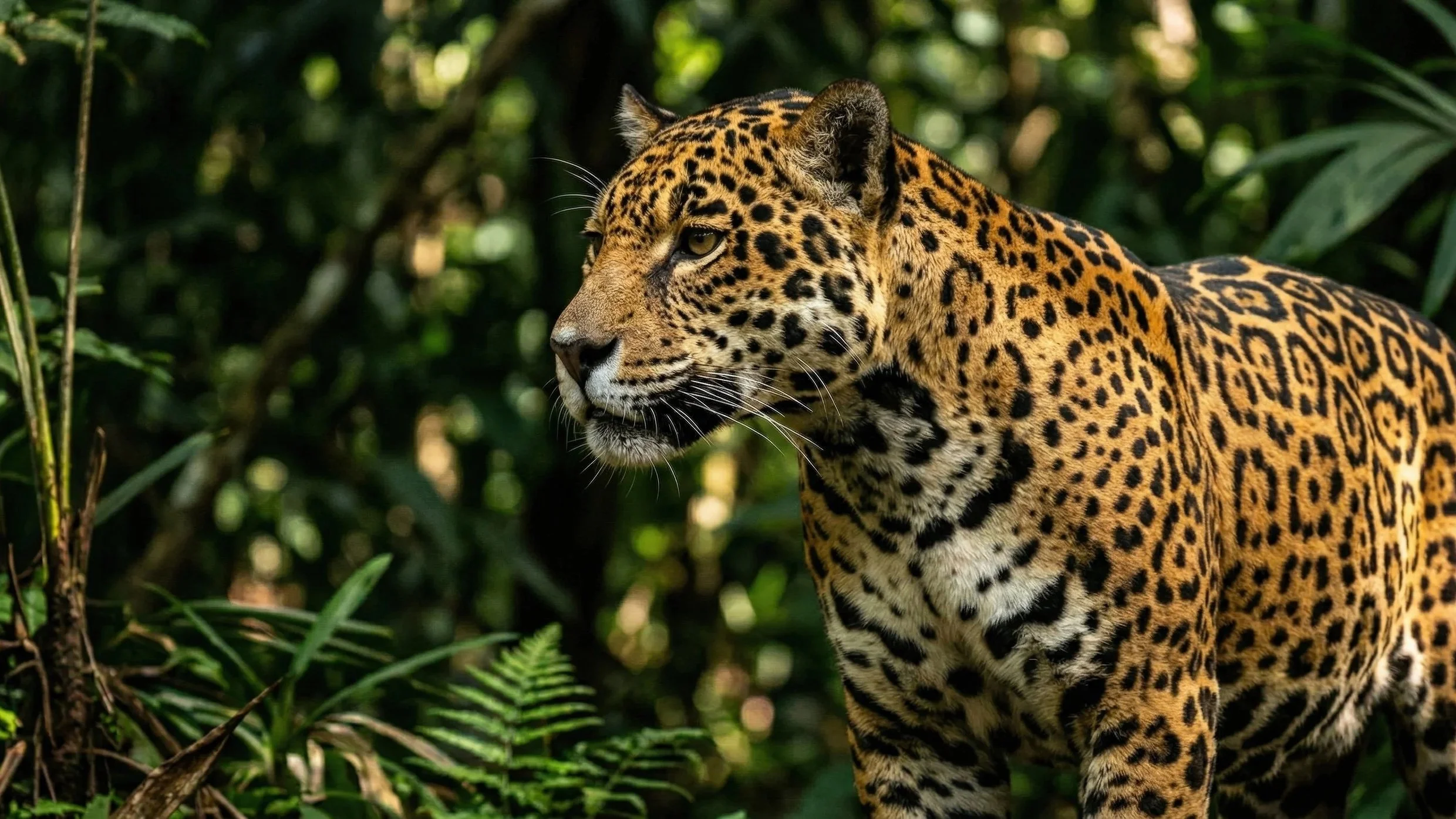
The jaguar is the apex predator of this ecosystem. When we track the jaguar, we are tracking the forest itself.
Jaguar density in Corcovado National Park nearly tripled in five years.
Each cell represents 100 km² of monitored park land, the actual unit the study measured density in.
A peer-reviewed 2025 study in Oryx confirms it: Corcovado's jaguars went from crisis to recovery, and rangers are why.
In 2007, researchers described the jaguars of Corcovado as being in a state of crisis. The study identified five resident male jaguars by name, Macho Uno, El Trotomundo, Espejo, Calvin, and Don Álvaro, meaning their home ranges sat almost entirely within the park for years at a time. Macho Uno was first photographed as a juvenile in 2008 and rediscovered from 2015 onward; the study now describes him as among the oldest wild jaguars ever recorded. Researchers point to one thing above all as critical to sustaining the recovery: protected, connected corridors, and the ranger presence needed to hold that ground.
That is what a $25 contribution funds. Not an abstraction. Ranger hours, camera-trap maintenance, and corridor protection, the exact conditions this study found responsible for a jaguar population moving from crisis to recovery.
Source: Olson, E.R., Shen, Y., Matzinger, P.J., Solano Mora, E.T., Saborío-R., G., & Azofeifa, A. (2025). "Conservation crisis? Status of jaguars Panthera onca in Corcovado National Park, Costa Rica." Oryx. Published online 23 January 2025 by Cambridge University Press on behalf of Fauna & Flora International. Camera-trap access granted by Costa Rica's National System of Conservation Areas (SINAC). doi.org/10.1017/S0030605324001170
Why the people.
A jaguar's recovery means little if the people beside it have no reason to protect it. This is what changes that.
Near Corcovado, a community once dependent on hunting for survival has become one of the only places in Costa Rica where pumas and Baird's tapirs move freely alongside people, without fear on either side. The shift did not come from a campaign. It came from income: guiding, monitoring, hosting, work that made the forest worth more standing than felled.
This is the layer conservation funding leaves out when it stops at wildlife. A $25 contribution that only ever reaches a ranger's equipment budget is doing half the job. Conservation Wellness partners are held to the same standard the Osa itself is proving works: protection that pays the people closest to it.
Source: "Costa Rica Film Highlights Osa Community Protecting Pumas and Tapirs," The Tico Times, May 2026, profiling the documentary Living with Pumas and Tapirs (BirdnWild).
This is the complete, sourced version of the argument behind Conservation Wellness: the recovery data, the funding crisis, the threat replacing it, and the proof that this model already works at the property level. Every figure below is independently sourced.
The wellness industry is moving from sustainability claims to verified outcomes. Every figure below is sourced, not asserted. Hover the marker to see where it comes from.
2.5% of all life on Earth, in 0.0008% of its land surface.
Traffickers moving illicit goods through the Osa Peninsula are laundering proceeds through illegal mining operations, some of them inside Corcovado National Park itself. Rangers and NGOs working the area describe finding the equipment and financial backing of organized operations, not opportunistic small-scale mining.
In one documented case, a team of eight rangers left the Patos outpost at 2 a.m. for a ten-kilometer trek to reach a reported illegal mining site inside the park. This is what a shrinking ranger budget is up against. Not just fewer patrol hours, but a better-funded adversary moving into the space those hours used to cover.
Source: InSight Crime, "Cocaine and Gold: The Battle to Protect Costa Rica's Corcovado National Park," May 2026. insightcrime.org
This isn't a distant problem. It's happening inside Corcovado, right now.
You are likely asking two things: will a mandatory $25 line item cost you bookings, and what happens if a competitor undercuts you by skipping it.
On the first: 36% of travelers already favor certified stays even while doubting the label iBooking.com Travel & Sustainability Report 2026. . This means the willingness is already there, waiting on proof they can trust. On the second: undercutting on price has never been the differentiator this guest is shopping on. A named ranger patrol, in a report with your lodge's name on it, is not something a discount competes with.
A single lodge running its own fee reports to no one but itself, can't extend to a neighboring property or an independent practitioner, and stops the moment leadership changes. That is the gap between one generous lodge and an industry standard, verified by a third party, held to the same reporting requirement everywhere it's used, and open to every practitioner, not just the properties large enough to build it themselves.
One lodge proved a stay can fund a ranger.
Conservation Wellness is what happens when every lodge and every practitioner are held to that same proof, verified, not just trusted.
Verified across every lodge on the Osa Peninsula, so conservation stops depending on grants that can vanish overnight.