
Eleven jaguars were detected over seven years. These are the ones researchers came to know by name.
Camera-trap identity is confirmed by matching individual rosette patterns across thousands of images. What follows are the residents, the newcomers, and the one recorded case of successful breeding that a seven-year study inside Corcovado National Park was able to document, name by name.
Eleven jaguars, fully named. Five residents anchor the population; the rest tell you it's still growing.
Photography of named individuals is held by the JaguarOsa research partnership and pending licensing; the frames below are placeholders, not missing images. Residential status (resident / transient / undetermined) follows the classification used in the published study, not a description we assigned ourselves.
Among the oldest wild jaguars ever documented. First photographed as a juvenile, still active in the population years on, the subject of his own published case study.
One of five resident males whose activity centers sat almost entirely inside Corcovado's boundary. Documented mating with Vivi in 2021.
A long-tenured resident male, part of the core group that gave researchers enough repeat detections to model survival and recruitment with confidence.
Repeat detections across multiple years placed Calvin firmly in the resident category, the classification that anchors the density model's core estimates.
The fifth of the five named resident males. Together, this group is the backbone of Corcovado's confirmed breeding population.
Photographed mating with El Trotomundo in 2021, then visibly nursing. Classified as transient in the formal model, though researchers believe she was likely present in her home range throughout the study, a known detection bias against females.
The second confirmed female of the 11-jaguar dataset, detected in a single year. Under-detection of females is a documented bias in camera-trap studies generally, so a single detection likely understates her actual presence.
Recorded as a recently independent young adult male, direct evidence that reproduction and dispersal were happening inside the park during the study.
Detected across two consecutive years but not enough to meet the study's threshold for resident status.
A single detection, in the final years of the study, too recent to classify as resident or transient with confidence.
Detected in the study's final two years; like Coco, too recent a first detection for the study to confidently classify.
Three zones of Corcovado carried most of the activity.
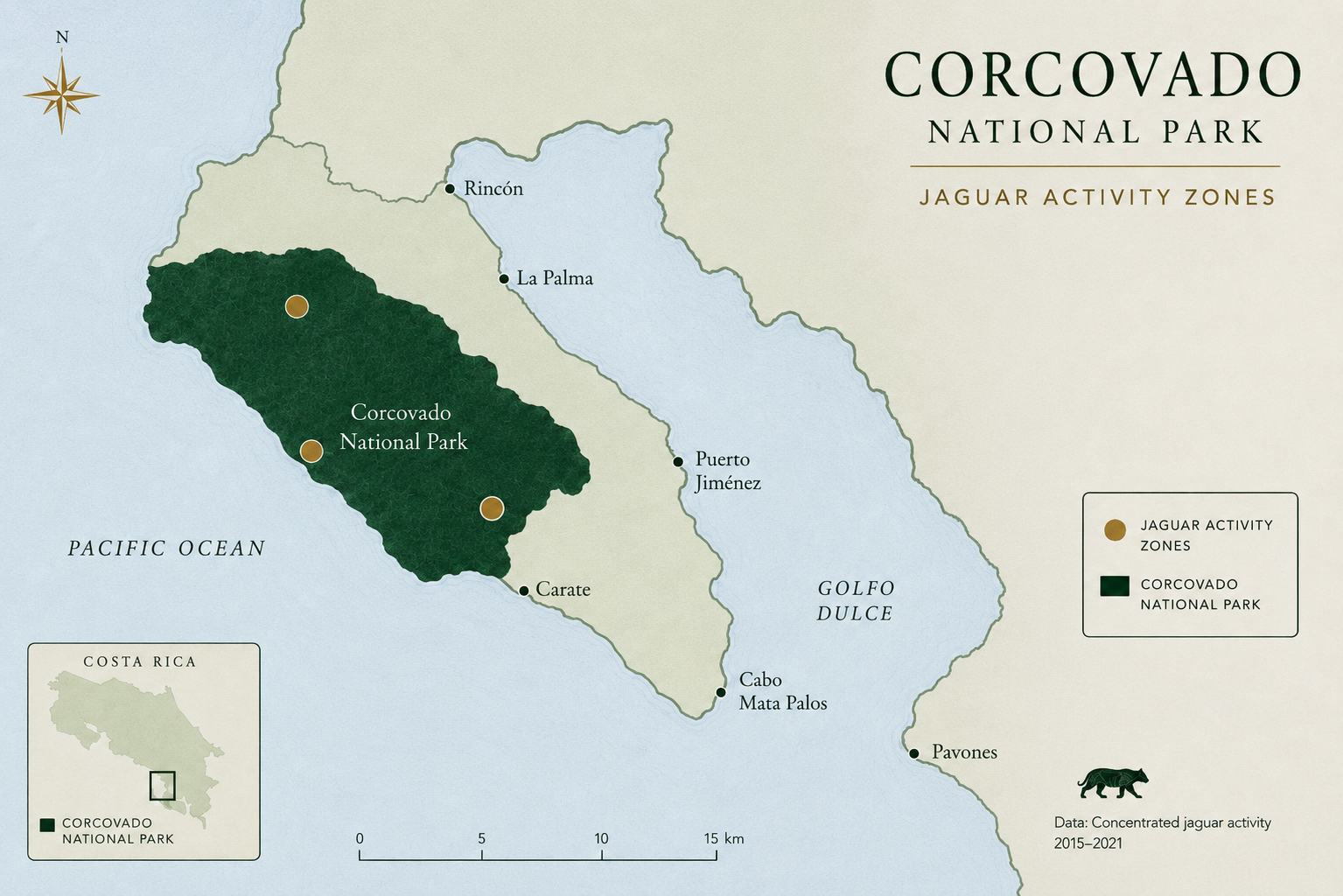
The full seven-year dataset.
| Metric | |
|---|---|
| Individual jaguars detected, 2015 to 2021 | 11 |
| Sex breakdown (males : females) | 9 : 2 |
| Confirmed resident males | 5 |
| Estimated annual survival | ~90% |
| Estimated annual recruitment | ~2.0 |
| Camera-trap coverage, share of park per year | 23 to 59% |
| Density, 2015 → 2021 (per 100km²) | 0.44 → 1.21 |
| Confirmed mortalities during the study | 1 |
Four steps, not a guess.
Camera trap
Motion-triggered cameras record both flanks over thousands of images per station.
Pattern match
Individual rosette patterns are matched flank-by-flank across the full image set.
Repeat detection
An individual is confirmed resident only after repeat detections across multiple years.
Peer review
The full seven-year dataset was published and reviewed before any name went public.
So what does this mean for Corcovado, specifically?
The most recent field data says something the "crisis" narrative repeated across most jaguar coverage doesn't: Corcovado's jaguars may actually be doing better, not worse.
A 2025 peer-reviewed study using long-term camera-trap monitoring inside Corcovado National Park (2015 to 2021) found jaguar densities rising over that period, comparable to other relatively stable populations elsewhere in their range, evidence against, not for, an active collapse inside the park itself. SINAC separately designates the Osa Peninsula as one of only six national priority conservation areas for the species.
Every jaguar page opens with a population figure. Almost none explain the gap.
The two most-cited range-wide estimates disagree by a factor of 2.7. Both are from 2018, from two independent research teams, and the disagreement comes down to a modeling choice, not new evidence on one side.
Published by Jędrzejewski et al. in 2018, using a range-wide statistical model of density and habitat suitability (estimating jaguar numbers across areas that were never directly surveyed, based on habitat quality). This is the figure most often cited by WWF and in IUCN-linked summaries today.
Source: Jędrzejewski et al., PLOS ONE, 2018Published the same year by de la Torre et al. in the journal Oryx, applying stricter cutoffs for human population density when extrapolating suitable habitat (assuming fewer jaguars survive in areas with more human activity), a methodological choice that produced a far more conservative number from similar underlying data.
Source: de la Torre et al., Oryx, 2018Arizona to Argentina, on paper.
The jaguar's historic range was the largest of any cat in the Americas. What's left is just over half of it, and the missing half isn't evenly distributed. The edges of the range vanished first.
The precise 51% figure is from the IUCN Red List assessment itself (Quigley et al.). WWF's own page rounds this to "approximately 50%" for a general audience, we've used the more precise primary figure and cited its actual source.
Range countries remain
From Mexico to Argentina, down from a continuous range that once ran unbroken through the southern United States.
Source: WWF species page, 2025Of the global population is in the Amazon
The Amazon subpopulation alone accounts for roughly 89 to 90% of all jaguars, by both range-wide estimates above. The 18 countries that share the species do not share it evenly.
Source: de la Torre et al., Oryx, 2018; Jędrzejewski et al., PLOS ONE, 2018Subpopulations outside the Amazon are threatened
Of the 34 recognized jaguar subpopulations, only the Amazonian one qualifies as Least Concern under IUCN criteria. A global "Near Threatened" label can hide how fragile most individual populations actually are.
Source: de la Torre et al., Oryx, 2018A 6,000-kilometer chain, one broken link at a time.
Panthera's Jaguar Corridor Initiative maps the path of least resistance between Mexican and Argentine jaguar populations, not a single trail, but a chain of forest fragments genetically linking 18 countries. Break enough links and the chain risks becoming 18 separate, genetically isolated islands, the same fragmentation risk documented in other large-carnivore populations, though it hasn't been directly measured in jaguars at this scale.
The bigger cause of death isn't the one that makes headlines.
The numbers below come from a survey of northern South America, not Costa Rica. We're showing them because no equivalent Osa-specific breakdown exists yet, and this is the closest documented regional picture. International trafficking gets the attention; across the surveyed region, it isn't the leading cause of human-caused jaguar deaths.
Based on a peer-reviewed survey of human-caused jaguar mortality across surveyed communities in northern South America, not Costa Rica specifically.
The teeth are going somewhere specific.
This is a documented case from Bolivia, not Costa Rica. We include it because it shows what the smaller, international-demand slice of the threat picture above actually looks like when it's followed all the way to a market.
A documented, traceable trade route runs from Bolivian forests to Chinese markets, in parallel to, and possibly substituting for, the collapsed global trade in tiger parts.
Exhibit A
Jaguar canines seized in trafficking cases linked to Chinese buyers or destinations, Bolivia, 2014 to Nov. 2023.
Source: peer-reviewed trafficking survey, 2023Exhibit B
Of all canines seized in a separate, 2014 to 2020 Bolivian dataset (673 canines total) came from the minority of trafficking events, just 42% of them, that were directly linked to China. A small share of cases accounted for nearly all of the seized volume. This is a different dataset from Exhibit A's 825-canine, 2014 to 2023 total, not a restatement of it.
Source: "Multi-lingual multi-platform investigations of online trade in jaguar parts," PLOS ONE, 2023Exhibit C
Estimated jaguars killed 2014 to 2023 to supply this trade route, derived from the 825 seized canines in Exhibit A at a standard rate of four canines per jaguar.
Source: derived from Exhibit A aboveWhat a predator holds up when it's still there.
A jaguar removed from a forest doesn't just disappear, it changes what that forest is made of, at least in theory. The chain below is a general trophic-cascade mechanism, well documented in other large-predator systems worldwide. It hasn't been measured end-to-end in jaguars specifically, so treat it as the best current hypothesis for what an apex predator's presence holds up, not a confirmed jaguar-specific pipeline.
Apex predation pressure
Jaguars have been recorded preying on more than 85 species, the widest documented diet breadth of any big cat in the Americas.
Sourced, WWF, 2025, citing primary researchMesopredator & herbivore release
Remove the apex predator and mid-sized prey and mesopredator populations rise unchecked (smaller predators and grazing animals, no longer kept in check, increase in number), a pattern documented in large-carnivore systems from Yellowstone to the Amazon.
Established ecological mechanismVegetation & regeneration pressure
Higher herbivore density suppresses seedling survival and shifts forest composition over time.
Established ecological mechanismSoil carbon chemistry
Forest composition shifts change litter input and root turnover (how much decomposing leaf and root material builds up and stores carbon in the soil), the pathway by which apex predators are increasingly linked to carbon storage outcomes.
Emerging research area, inferential linkThe trafficking story is the one that travels: a smuggling ring, a market overseas, teeth in a suitcase. Regionally, it's also the smaller cause of death. The harder story to tell well is the one at the fence line between a cattle pasture and the forest edge, and that's the one covered next.
You don't have to trust us. You get the grading.
Conservation claims, ours included, are usually stated with more confidence than the underlying research supports. So every fact below is graded by what it actually rests on: a peer-reviewed study, a field survey, an NGO's own figure, or something still unverified, not by whether we believe it.
Based on the specific claims graded below, not a general reliability score for jaguar conservation writing.
Eighteen countries, one shared animal.
| Region | Countries |
|---|---|
| North / Central America | Mexico, Belize, Guatemala, Honduras, El Salvador (functionally extirpated), Nicaragua, Costa Rica, Panama |
| Andean & Northern South America | Colombia, Venezuela, Ecuador, Guyana, Suriname, French Guiana |
| Amazon Basin & Southern Cone | Brazil, Peru, Bolivia, Paraguay, Argentina (critically reduced) |
Global numbers, local accountability.
None of the above is background reading. It's the basis for a simple standard: a lodge operating near jaguar habitat should be able to show, specifically, what its conservation fee funds, not claim a vague benefit to "the ecosystem."
That's the standard Conservation Wellness holds its certified partners to: verified, itemized conservation contributions, not marketing language. If you manage a lodge on the Osa Peninsula, this is the bar. If you're planning a stay here, this is what your certification badge is supposed to mean.
We don't yet have Osa-specific mortality data, a verified current jaguar count for Corcovado, or independent confirmation of the Barbilla corridor segment's connectivity. Those gaps are noted throughout, not hidden. If you hold that data, primary sources, get it in touch.
Working with jaguars on the ground in Osa? This dataset is meant to grow with you.
If your NGO operates inside or near Corcovado, you can contribute directly to this record, a new camera-trap detection, a mortality, a territory shift, and help keep donors looking at real, current numbers instead of a static report. You can also join the small group of partners piloting shared reporting standards across the peninsula.
SOURCES
- Olson, E.R. et al. (2025). "Conservation crisis? Status of jaguars Panthera onca in Corcovado National Park, Costa Rica." Oryx, 59(3), 351 to 362.
- Olson, E.R. et al. (2025). Corrigendum. Oryx, 59(1), 136. A published correction affecting two individuals' identities; density estimates shifted slightly lower, conclusions unchanged.
- Fieldwork conducted under JaguarOsa, a partnership between Northland College and SINAC's Osa Conservation Area (ACOSA). Photography of named individuals is held by the research partnership.
- Jędrzejewski et al., "Estimating large carnivore populations at global scale based on spatial predictions of density and distribution," PLOS ONE, 2018. Source of the 173,000 range-wide estimate.
- de la Torre et al., "The jaguar's spots are darker than they appear," Oryx, 2018. Source of the 64,000 range-wide estimate and the subpopulation-level threat findings.
- Alvarenga et al., Amazon camera-trap density study across 22 protected areas, reported via Mongabay, May 2025. A corroborating 2025 data point, not the source of either headline estimate.
- Quigley, Foster, Petracca, Payan, Salom & Harmsen, IUCN Red List assessment for Panthera onca, 2017 (errata 2018). Primary source of the precise 51% historic-range figure and the Near Threatened classification.
- WWF jaguar species page. Range country list and the 85+ recorded prey species figure. WWF's own page rounds the range figure to "approximately 50%."
- Peer-reviewed jaguar-trafficking survey (Bolivia and China canine seizures), 2023. Source of Exhibit A (825 canines, 2014 to Nov. 2023) and the basis for the derived Exhibit C figure.
- "Multi-lingual multi-platform investigations of online trade in jaguar parts," PLOS ONE, 2023. Source of Exhibit B (the 95.4%-of-673-canines figure, 2014 to 2020 Bolivia dataset), a separate dataset from Exhibit A, not a restatement of it.
- Petracca et al., "Robust inference on large-scale species habitat use with interview data: the status of jaguars outside protected areas in Central America," Journal of Applied Ecology, 2018. Basis for the locally documented Central American threat profile.
- Arias et al., survey of human-caused jaguar mortality, northern South America, University of Oxford. Basis for the 52% subsistence/commercial hunting and 38% retaliatory killing figures.
- Olson et al., "Conservation crisis? Status of jaguars Panthera onca in Corcovado National Park, Costa Rica," Oryx, 2025. Basis for the local density-recovery finding.
- SINAC, "Estado de Conservación del Jaguar (Panthera onca) en Costa Rica," 2018. Basis for the Osa Peninsula priority-area designation. (Not independently linked, we could not confirm a stable public URL for this specific report.)